

September 9, 2026
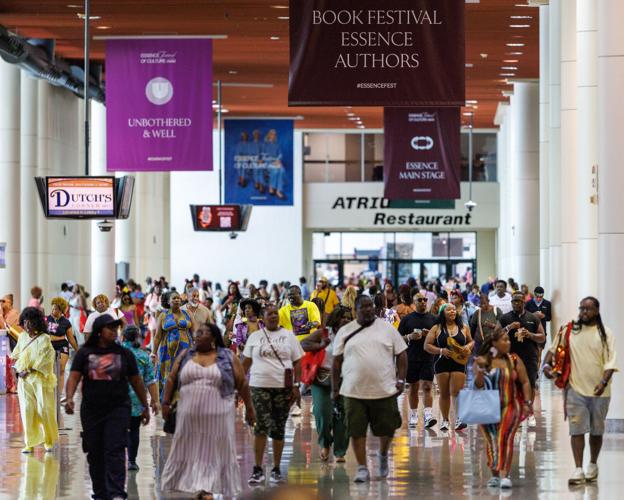
Baton Rouge and New Orleans are planning major expansions of their convention facilities in an attempt to get a larger share of the increasingly competitive events business.
A team has been assembled in Baton Rouge to tackle the redevelopment of the aging Raising Cane’s River Center, replacing it with a long-awaited convention center and headquarters hotel. New Orleans, already used to hosting major events, is planning a new headquarters hotel to accompany the Ernest N. Morial Convention Center, which is undergoing renovations. But a few financial hoops must be cleared before the hotel is a reality.
Cities across the United States are investing millions in infrastructure to support large, multiday events as attendance makes a slow but sure recovery from the pandemic. International conflict and rising operational costs are making it harder to attend and host events, encouraging planners to prioritize fewer conventions, according to an international outlook by the Professional Convention Management Association, whose members collectively organize more than 3 million events annually.
“Competition is only getting stiffer and stiffer,” said Sherrif Karamat, CEO of PCMA.
The River Center saw more than 100,000 more visitors last year than it did in 2019 and the New Orleans Convention Center had returned to pre-pandemic event numbers by 2023, though attendance numbers lagged. PCMA’s annual market survey found that almost half of respondents, many of whom are meeting planners, saw an increase in attendance at their most recent in-person event compared to the last pre-pandemic event, though the increase hasn’t been seen all around the industry.
The increase in business isn’t coming from the cities one might expect. Second-, third- and fourth-tier cities like Columbus, Ohio, and Indianapolis are ramping up their game, Kamarat said, as the competition heats up on an international stage.
Dollars from conventions and meetings flows into vendors, hotels, local businesses and transportation. A key tenet is their multiday or even multimonth structure, making the economic impacts of smaller, more frequent events like concerts pale in comparison.
Louisiana has a strong foundation for hosting with its renowned culture and traditions, Karamat said, but continued investments in convention centers, hotels, airports and other infrastructure are key to future success in the modern events industry.
“They give you a little bit of fame in a moment,” he said of sporadic, seasonal events. “But business events are every day during the course of the year that are driving economic growth in different sectors of that community, and it’s creating permanent jobs in different sectors.”
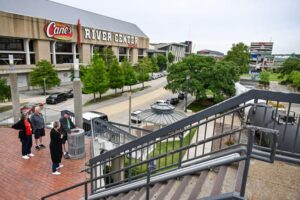
A group of pedestrians walk over the foot bridge nearby Raising Cane’s River Center and Repentance Plaza along the Mississippi Riverfront on Wednesday, May 7, 2026. Staff photos by Javier Gallegos
Infrastructure investments
Inaction and contract disputes have plagued convention center improvements in Baton Rouge and New Orleans. But it’s not too late for them to step up their game. High demand for events signals room for Baton Rouge and New Orleans’ construction to get a bite of event industry growth, Karamat said.
“This is just a matter of our community really focusing on something that has been needed, but there’s been other priorities,” said Charles Landry, a Baton Rouge attorney who is involved in the River Center redevelopment and the new LSU arena. “Well, now this has become one and that’s very important.”
The redevelopment won’t occur in a vacuum — downtown Baton Rouge plans to revitalize its riverfront with a youth sports complex and other amenities to create a more attractive “front porch” to the city, according to the Plan Baton Rouge III road map for development.
Baton Rouge can serve as an alternative location for events with dates that may not work out in New Orleans venues, he said. Given its central location between New Orleans, Lafayette and St. Francisville, visitors can bounce between the cities and see what south Louisiana has to offer.
Access to the cities is key, Karamat said, nodding toward Nashville, Tennessee, and its Music City Center, which has brought in more than $4 billion in direct economic impact in the past decade, as an example.
The center is in early planning stages for expansion, running concurrently with expansions at Nashville International Airport, which has a $4.5 billion plan to accommodate 40 million passengers annually. The airport saw 26.7 million passengers in the most recent fiscal year.
New Orleans is gearing up to support even more visitors in the future with a $3.6 million Louis Armstrong New Orleans International Airport master plan for the next 20 years that could bring a new terminal, gates and parking garage, in addition to ongoing projects like a connector road for express shuttles. The River District area surrounding the Convention Center is undergoing a makeover, including a renovation to the Audubon Aquarium and the new Goldring Woldenberg Riverfront Park.
“We have to continue investing and evolving if we want to win new business and keep longtime customers coming back,” Jim Cook, president and CEO of the Convention Center, said in the statement.
The New Orleans Convention Center, which hosts more than 100 events each year, will be able to attract 27 more conventions each year with the addition of a headquarters hotel, according to an analysis by hospitality consulting firm HVS. The Convention Center commissioned a study from PCMA members on the impact of the headquarters hotel plan, which found that 82% of respondents would be more willing to plan events in New Orleans if the center had a hotel.
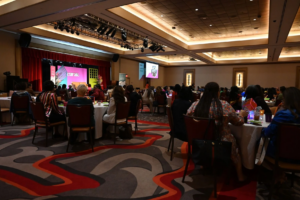
A previous Curate Conference
High expectations
Business events have stepped up their game over the years, providing out of the box gifts that go beyond the typical branded pens and tote bags. It’s raised the stakes for conference planners, said Victoria Armstrong, founder of Curate For Women Who Work.
Curate, based in Baton Rouge, has hosted an annual conference for the past five years and will host in New Orleans for the first time this month. Armstrong said the Crescent City has a larger capacity for large, multiday events than Baton Rouge and is a part of a natural progression for the conference as it moves toward a long-term goal of hosting in a new city each year.
Low hotel capacity is a struggle for hosting Baton Rouge events, she said, having to factor in capacity, transportation and safety of her guests as they leave events at night to travel back to their hotel. There are 8,500 hotel rooms in East Baton Rouge Parish, but 2,000 are committable — meaning the hotel and planners can agree to block out rooms for a specific events, according to Visit Baton Rouge.
There are more conferences, brunches, networking events, especially between Baton Rouge and New Orleans,” Armstrong said. “I think that’s really good for the ecosystem.”
Meeting planners also look for convenience, said Cook from the Morial Convention Center. Planners must block out hotel rooms and coordinate meeting spaces for large events, making a headquarters hotel a key piece for easy planning.
Other emerging values sought in host cities are sustainability, technology and community engagement, he said.
“We already have what so many destinations are trying to create — the culture, hospitality, food and experiences people want,” Cook said.